Travel notebook
Quang Ninh seafood specialities explained
Not every regional speciality comes from Ha Long Bay. Learn what unfamiliar Quang Ninh seafood names mean, where protected products originate and what to ask before ordering.
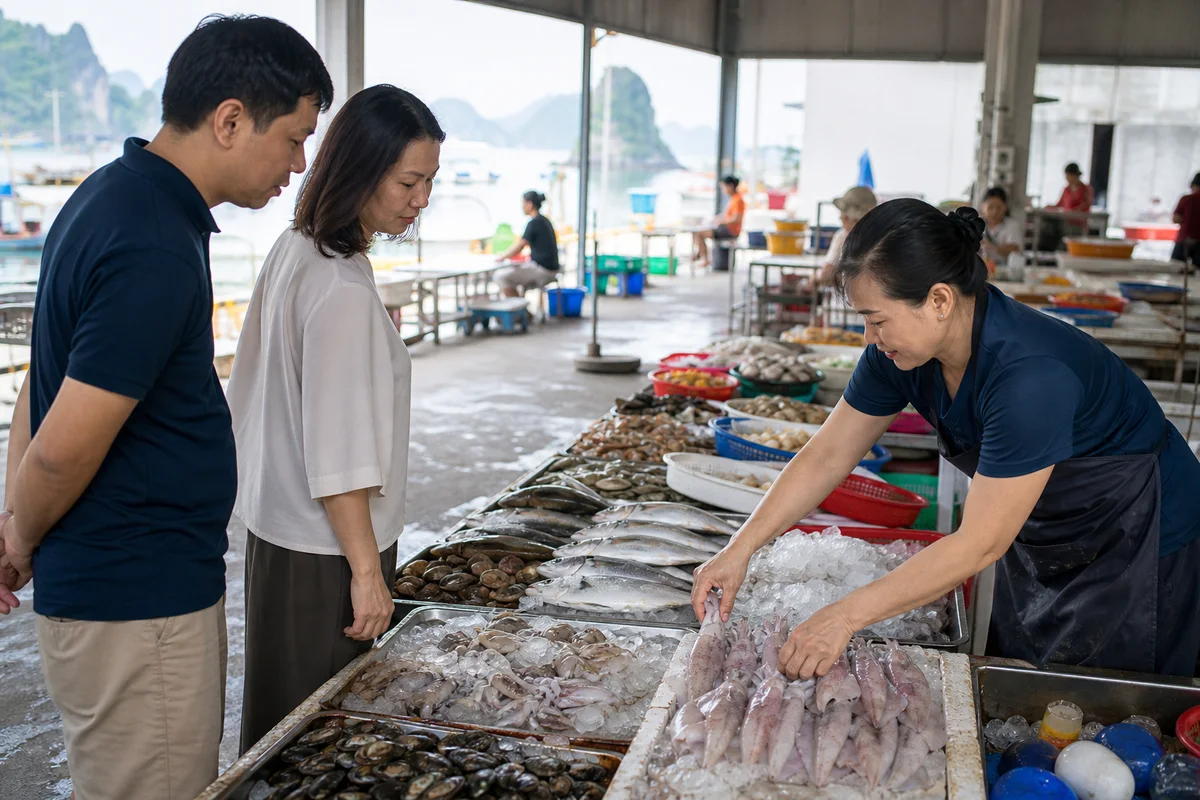
Restaurant menus in Ha Long often combine products from the city, the wider Quang Ninh coast and other parts of Vietnam. That is normal for a provincial tourism centre, but it makes geographical language important: Ha Long, Quang Ninh and Van Don are not interchangeable origin labels.
This guide explains several names a visitor may encounter. It does not certify a restaurant’s supply chain. If origin matters, ask where the current batch came from and whether a packaged product carries the protected indication it claims.
Quick menu decoder
| Vietnamese name | Plain-English orientation | What to ask |
|---|---|---|
| Ngan | A large local bivalve associated with tidal mud and mangroves | Grilled, steamed, in porridge or another preparation? |
| Sa sung | A marine peanut worm harvested from intertidal sand flats | Fresh or dried, and used as the main ingredient or broth seasoning? |
| Be be | Mantis shrimp | Sold by weight or as a prepared portion? |
| Tu hai | A burrowing clam, sometimes loosely translated as “geoduck” | Exact species, origin, weight and cooking method? |
| Hau | Oyster | By piece or plate, and raw, grilled or steamed? |
| Cu ky | A regional crab name with inconsistent English translations | Which animal is being offered and how much does the whole item weigh? |
| Muc | Squid or cuttlefish | Whole seafood dish or prepared cha muc? |
Use the English descriptions for orientation, not allergy decisions. Common names vary between menus; the kitchen needs to identify the actual ingredient.
Ngan Quang Ninh: a protected regional bivalve
Ngan is a bivalve mollusc whose scientific name is Austriella corrugata. Vietnam’s Intellectual Property Office registered “Quang Ninh” for ngan as geographical indication number 00041 in March 2014. The registration links its characteristics to brackish tidal mud, river mouths and mangrove ecosystems in specified parts of the province.
This is not simply a clam renamed for tourists. It is a defined regional product with an origin area wider than Ha Long City. The registration named production locations in parts of Tien Yen, Dam Ha, Van Don, Quang Yen and Hai Ha as those administrative units were described at the time. Because local administrative names can change, use a current map for travel rather than turning the old legal list into an itinerary.
Official provincial food material records ngan being prepared in several ways:
- grilled or steamed;
- cooked into porridge;
- stir-fried with noodles or vegetables;
- incorporated into newer restaurant dishes.
Choose one uncomplicated cooked preparation for a first taste. Confirm whether the listed price is per animal, plate or kilogram, and ask whether the shell-on weight is used.
What about ruou ngan?
Ruou ngan is an alcoholic regional preparation found in some accounts and menus. Treat it as alcohol, not a tonic or medical experience. Ask what has been mixed into the drink, avoid it if the shellfish ingredient is unsuitable for you, and never drive after drinking. There is no basis here for claims that it improves health or sexual performance.
The Intellectual Property Office’s ngan registration account is the primary source for the protected name, species and production geography.
Sa sung Van Don: fresh ingredient and dried seasoning
Sa sung is a marine invertebrate commonly called a peanut worm in English. The protected Van Don product is Sipunculus nudus. It lives in intertidal sand flats rather than on a seafood farm display designed for visitors.
The Intellectual Property Office registered “Van Don” for sa sung as geographical indication number 00047 in November 2015. Its account names the Minh Chau and Quan Lan island areas and describes traditional collection and processing. It also distinguishes fresh prepared product from dried product.
Dried sa sung has long been used in small quantities to deepen the savoury flavour of broths. On a menu, therefore, “with sa sung” may mean a broth ingredient rather than a plate piled with visible pieces. Ask whether it is fresh, dried or used only in stock.
Read the Intellectual Property Office’s Van Don sa sung record for the species, registration and geographical-area details.
Buy carefully, not competitively
Sa sung is a high-value natural resource. Provincial planning material identifies protected-resource areas for both sa sung and ngan, while aquaculture and conservation research continue. A high price or a claim of being “wild” does not prove lawful, careful sourcing.
Ask for the producer and origin on a packaged item. Do not join an informal digging activity in a tidal habitat, buy a product whose origin cannot be explained, or frame consumption as a challenge. A guide cannot determine the legality or sustainability of an individual restaurant’s batch.
Be be: mantis shrimp without the menu confusion
Be be is mantis shrimp, a crustacean frequently associated with seafood meals and noodle soup in Ha Long. It has a hard shell relative to its edible flesh, so clarify whether a restaurant price uses whole shell-on weight or a prepared portion.
Common formats include steaming, grilling and adding the meat to noodle soup. Preparation varies by kitchen; do not infer that a bowl of broth is shellfish-free because no whole shrimp is visible.
For a simple first order, a fixed portion or noodle bowl is easier to price than selecting several large animals from a tank. Anyone allergic to crustaceans should avoid both the meat and a broth made with it, subject to their own medical guidance.
Tu hai, oysters and other Van Don menu names
A current Van Don government food guide lists tu hai, oysters, be be, crab, squid, abalone and marine fish among the area’s seafood choices. That confirms the regional vocabulary, not today’s availability at a particular restaurant.
Tu hai
Tu hai is a burrowing marine clam. English menus sometimes call it geoduck, but common-name translations are inconsistent and should not be used as a scientific guarantee. Ask to see the item, confirm its origin and weight, and choose a thoroughly cooked preparation.
Oysters
Oysters may be sold individually or by plate and offered raw, grilled or steamed. The World Health Organization advises travellers to avoid raw seafood and choose food that is thoroughly cooked and served hot. Grilling toppings until melted does not by itself prove the oyster below was cooked through, so state your preference clearly.
Cu ky and crab names
Cu ky is a regional crab name, but English menu translations vary. Do not assume it means the same animal as cua or ghe. Ask which item is being weighed and how it will be served. Whole-animal pricing includes shell.
The Van Don government’s current food overview is a useful official source for the range of names and common cooking styles.
Cha muc belongs in the food map too
Ha Long’s best-defined city speciality is cha muc, a fried cuttlefish cake with its own protected geographical indication. It is often easier to try than an unfamiliar live-seafood order and works as breakfast with rice rolls or sticky rice. See the dedicated Cha muc Ha Long guide for its protected origin, traditional preparation and takeaway checks.
Build a tasting order that makes sense
For two people, ordering five species by weight is more likely to create waste than insight. A more useful progression is:
- Choose one regional speciality in a simple cooked preparation.
- Add rice, vegetables or noodles to make a complete meal.
- Confirm whether sauces or broths contain additional seafood.
- Establish item, unit, weight, cooking fee and estimated total before preparation.
- Add another dish only if the first order is an appropriate size.
Our Ha Long seafood ordering guide gives a step-by-step price and weighing checklist.
Allergy and food-safety boundary
Ngan, sa sung, tu hai, oyster and squid/cuttlefish are molluscs or other marine invertebrates; be be, crab and shrimp are crustaceans. Fish is another category. Cross-contact is common in a seafood kitchen through broths, fryers, steamers, grills, utensils and sauces.
Carry a professionally translated allergy card that names your exact trigger. Show it before ordering and ask about shared equipment. If the staff cannot identify an unfamiliar animal or the broth ingredients, choose something else.
For general traveller safety, prefer food cooked thoroughly and served steaming hot. The WHO safe-food guide advises avoiding raw seafood.
Claims this guide deliberately does not make
- That a food cures illness, increases vitality or has aphrodisiac effects.
- That “wild-caught” automatically means legal, sustainable or higher quality.
- That every regional seafood item was harvested inside Ha Long Bay.
- That a geographical indication certifies an individual restaurant.
- That a species is endangered merely because conservation work exists.
- That an old price, harvest calendar or administrative address remains current.
Sources and live checks
- Intellectual Property Office of Vietnam: Quang Ninh geographical indication for ngan.
- Intellectual Property Office of Vietnam: Van Don geographical indication for sa sung.
- Van Don government: current regional food overview.
- Quang Ninh provincial portal: documented preparations for ngan.
- WHO: safe food for travellers.
Verify at the restaurant: the actual species, origin claim, price unit, weight, cooking method, ingredients and current availability.
Put it on the map
Addresses and map points
Use these points for orientation, then match the exact terminal, entrance or meeting place to your current confirmation.
Van Don
Van Don, Quang NinhVietnamThe wider island district associated with protected Van Don sa sung and several regional seafood products.
Quan Lan Island
Van Don, Quang NinhVietnamOne of the island areas named in the geographical-indication record for Van Don sa sung.
Keep exploring