Travel notebook
Quan Lan and Minh Chau beaches: island guide
Quan Lan and Minh Chau reward travellers who treat them as a separate Bai Tu Long island stay, with a passenger boat, local transfer and weather margin of their own.
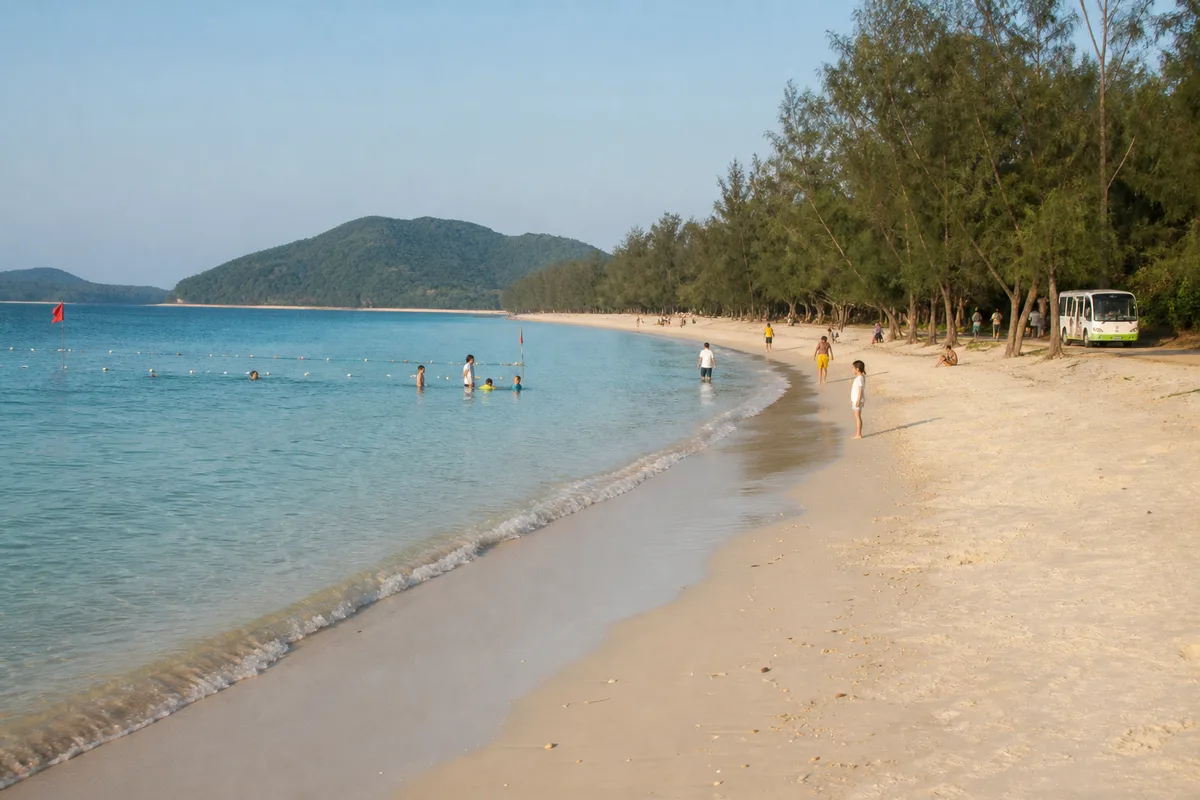
Quan Lan and Minh Chau are for travellers who want the beach to be a destination, not a short pause during a Ha Long cruise. The island area lies toward Bai Tu Long and uses a passenger-boat connection from the Van Don side, followed by local transport to the final beach and accommodation.
Give the journey its own nights. Trying to fit an outward boat, beach visit and return sailing into a narrow day removes the weather margin that island travel needs.
First, separate this trip from Ha Long Bay cruising
A standard sightseeing cruise from Tuan Chau or Ha Long International Passenger Port does not deliver you to a Quan Lan or Minh Chau hotel. Current Quang Ninh reporting identifies Ao Tien Passenger Port in Van Don as the mainland departure point for island routes serving Quan Lan and Minh Chau.
Write the journey as four separate bookings or confirmations:
- your road transfer to Ao Tien;
- the passenger boat and its named island arrival pier;
- the local transfer from that pier;
- the accommodation and its distance from the intended beach.
If any step is blank, contact the boat operator or accommodation before travelling. “Transfer to Quan Lan” can mean only the water crossing.
Quan Lan or Minh Chau?
Both names describe established beach-and-stay areas within the same broader island destination. Quang Ninh’s 2026 tourism reporting shows active accommodation, passenger boats and electric vehicles serving the area. Minh Chau is repeatedly highlighted for its long pale sand, while Quan Lan combines its beach with the island’s historic communal house, pagoda and temple complex.
Do not select a hotel from the destination name alone. Ask for a map pin and road time to the beach you intend to use.
| Choose based on | Question for the accommodation |
|---|---|
| Beach access | “Which managed bathing zone do guests normally use, and how do we reach it?” |
| Arrival transfer | “Which pier should we book, and is pickup included in writing?” |
| Evening plans | “Can we reach food and the pedestrian area on foot, or do we need an electric vehicle?” |
| Quiet | “Does the room face an event street, generator, construction area or late restaurant?” |
| Return journey | “How early should we leave for our confirmed Ao Tien sailing?” |
There is no need to declare one beach universally better. The better choice is the one with a confirmed transfer, suitable room and currently supervised swimming area.
What current transport evidence establishes
During the April 2026 holiday period, Quang Ninh reported licensed departures from Ao Tien to island routes including Quan Lan and Minh Chau, with new vessels entering the Van Don–Minh Chau service. A June 2026 provincial report described electric vehicles operating continuously within the island area during peak demand.
This confirms the transport pattern, not a permanent timetable. Departure times, vessel companies, weather decisions and arrival piers can change. Obtain the latest information from the port or named operator and avoid screenshots of an undated schedule.
At Ao Tien:
- arrive with enough time to find the correct counter and pier;
- keep passports and tickets accessible but secure;
- confirm the final destination aloud before boarding;
- ask where checked luggage will be collected;
- wear the provided life jacket as instructed;
- keep medication and one dry layer in hand luggage.
Plan at least two nights when possible
Arrival day
Travel to Ao Tien, cross to the island and complete the road transfer without promising yourself a full beach afternoon. After checking in, locate the managed bathing area and read its signs. Use the evening for a meal and an early check of the next day’s weather.
Full island day
Swim only during the staffed period, then add one non-water activity: a village or heritage visit, a walk approved by local guidance, or unhurried time near your base. Do not fill the day with distant map pins merely because the island looks small on screen.
Departure day
Confirm the sailing again before leaving the accommodation. Take an earlier island transfer than the minimum estimate and preserve a substantial mainland buffer before any train, flight or long road connection.
One night can work, but it makes the visit much more dependent on two punctual sailings and good weather.
Use the managed beach, not an empty-looking shoreline
In June 2026, Van Don established local management and rescue arrangements for both Quan Lan and Minh Chau beaches. The published Quan Lan rules required bathing and water recreation to take place only when observation, warning and rescue staff were on duty. They provided for boundary floats, flags, warning signs, observation posts, loudspeakers and first-aid equipment.
Those rules also recognised rip currents and sudden weather as hazards. Follow the same practical discipline at either beach:
- use the currently marked bathing zone;
- swim only when the staffed period is operating;
- leave immediately when flags, whistles or announcements change;
- do not follow a social-media pin to an unmanaged cove for swimming;
- keep children within arm’s reach;
- use only inspected and authorised water-sports equipment;
- ask staff about currents instead of judging safety from the surface.
The 2026 rules contained date-specific summer hours. Do not treat them as permanent. Check the current local notice on arrival, particularly outside the main season.
Weather can suspend both beach and boat
Vietnam Tourism describes northern summer from June to August as hot, humid and storm-prone. Quang Ninh authorities may suspend passenger services and swimming when wind, thunderstorms or tropical weather create risk.
This affects both halves of the trip. A clear beach does not prove the return boat will operate, and an operating ferry does not prove swimming is permitted. Check the marine forecast, operator message and local beach notice separately.
Build these protections into the booking:
- flexible accommodation terms where possible;
- no tight same-day international departure after the return boat;
- enough essential medication for a delay;
- a written understanding of boat cancellation, rebooking and refund terms;
- contact details for the accommodation and boat operator stored offline.
April through June is often favoured for warmer, clearer conditions, but it is not storm-proof. September onward can still offer pleasant days while having fewer staffed beach services. The day’s official information is always more useful than a month-level promise.
Food and supplies on an island stay
The island areas have restaurants and growing accommodation services, but choice and payment systems can be more limited than central Ha Long. Ask the accommodation about breakfast, drinking water, late arrival meals, allergy communication and card acceptance before travelling.
For seafood, confirm the species, weight, unit price and cooking charge before preparation. Avoid buying or ordering protected wildlife, and do not collect live shells or animals from the beach. Our Ha Long food guide explains common dishes and safer ordering questions.
Carry personal medication, sun protection and a refillable bottle where local rules permit. Do not assume a specific imported product, infant supply or pharmacy item will be available near the beach.
Beach behaviour that protects the island
Take packaging and difficult waste back to a managed collection point. Avoid single-use items where a refill is practical. Keep away from dunes and planted areas used to stabilise sand, and do not drive or park on the shore.
Choose established paths and authorised activities. Empty sand is not permission to launch a motorised craft, light a fire, camp or enter the water outside the managed area.
When to choose somewhere easier
Choose Bai Chay Beach if you have only a few flexible hours from a Ha Long hotel. Choose Ti Top if you want a short beach-and-viewpoint landing inside a classic cruise route. Choose Cat Ba if Lan Ha boating and forest time are also priorities.
Quan Lan–Minh Chau is the stronger choice when you can spend several days, accept a weather-dependent passenger crossing and want the rhythm of an island stay. Compare every option in the Ha Long beaches guide.
Sources and live verification
- Quang Ninh’s April 2026 island report confirms passenger routes from Ao Tien toward Quan Lan and Minh Chau.
- Its June 2026 visitor report documents current beach demand, accommodation pressure and electric-vehicle transport.
- Van Don’s 2026 beach-management announcement covers the establishment of management and rescue teams for both beaches.
- Quan Lan Beach Decision 2213/QD-UBND supplies the supervised-swimming and safety framework.
- Minh Chau Beach Decision 2214/QD-UBND is the corresponding local authority record for Minh Chau.
- Vietnam Tourism’s Ha Long weather guide provides the broad seasonal context.
Reconfirm before leaving the mainland: Ao Tien departure, operator, island arrival pier, pickup, accommodation pin, beach operating status, staffed swimming period and the return-weather policy.
Put it on the map
Addresses and map points
Use these points for orientation, then match the exact terminal, entrance or meeting place to your current confirmation.
Ao Tien Passenger Port
Van Don, Quang NinhVietnamThe current mainland gateway for passenger services toward Quan Lan and Minh Chau; verify operator, pier and sailing on your date.
Quan Lan Beach
Van Don, Quang NinhVietnamUse the managed beach zone and current supervised period; similarly named island pins can be far apart.
Minh Chau Beach
Van Don, Quang NinhVietnamConfirm the final road transfer from your arrival pier; a ticket to the island is not automatically a hotel or beach transfer.
Keep exploring