Travel notebook
Getting around Ha Long City
A hotel labelled ‘Ha Long’ may not be close to your terminal. Use exact map points for the harbour, hotel and attraction before deciding how your day fits together.
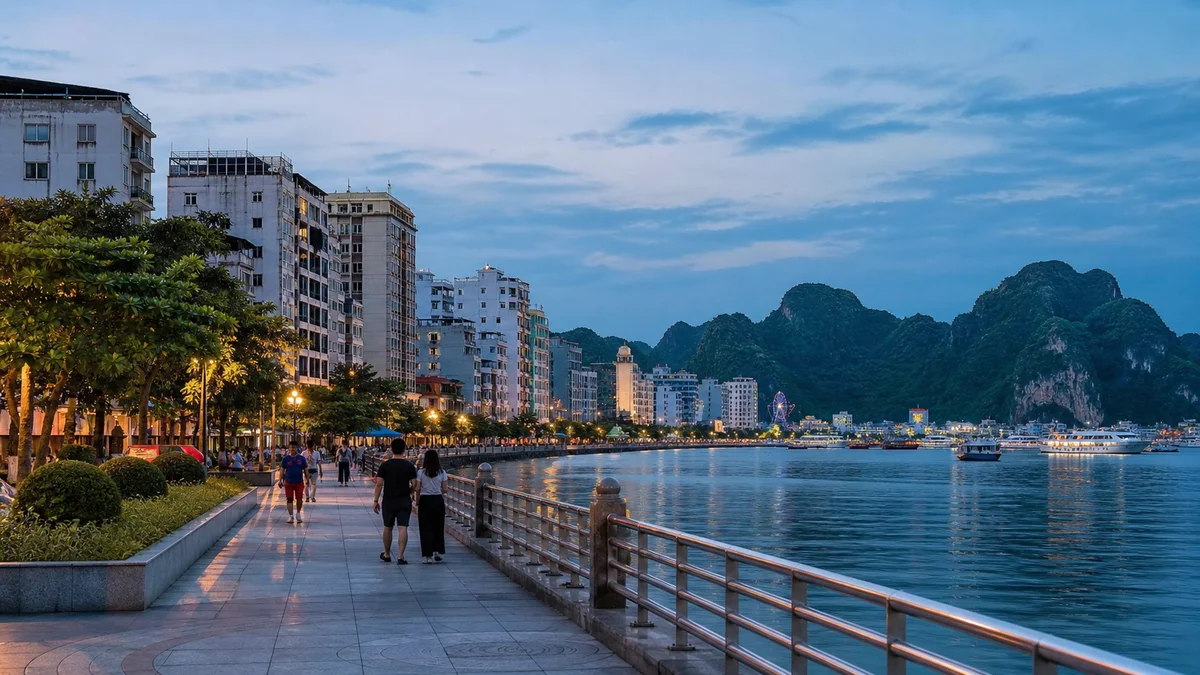
Ha Long’s urban area spreads around the Cửa Lục waterway. Bãi Cháy is the principal visitor area on the west side, the denser Hòn Gai and city-centre districts sit to the east, and Tuần Châu lies farther southwest. Bãi Cháy Bridge links the two main urban sides, but a short-looking map distance can still mean a vehicle journey when traffic, luggage or cruise movements are involved.
The Wikipedia overview of Ha Long is useful for geographic history, while official visitor updates come from Quảng Ninh Tourism and the Ha Long Bay management department.
| Area | Often useful for | Transport question to solve |
|---|---|---|
| Bãi Cháy | Visitor services, waterfront and Ha Long International Cruise Port | Is the hotel near the terminal entrance or merely in the same broad district? |
| Hòn Gai / central urban side | Market, museum and everyday city facilities | How much bridge-crossing time is needed before cruise check-in? |
| Tuần Châu | Departures specifically confirmed at Tuần Châu port | Does the booking require a terminal desk, hotel pickup or another marina point? |
Map three fixed points
Before booking transport, pin your hotel entrance, confirmed cruise terminal and any must-see land attraction. Use the exact names supplied by the operator. “Ha Long,” “Bãi Cháy port” and “cruise harbour” are not sufficiently precise transfer instructions.
Save four details offline for every fixed point:
- the map pin;
- the Vietnamese place name;
- a street or landmark description;
- a telephone or messaging contact.
This reveals whether walking is realistic and prevents a driver from choosing a similarly named terminal. It also shows whether a hotel promoted as “near the bay” is useful for your particular departure.
Taxis and booked cars
Use an identifiable licensed taxi, a booked-car provider or an app you can verify in Vietnam. Match the vehicle and driver details where the service provides them, follow the route on your own map and keep the destination available in Vietnamese. Do not accept an unsolicited offer merely because the driver says “cruise port.”
For a metered taxi, check that the meter is used appropriately; for a quoted ride, agree the total, tolls, waiting and payment method before departure. Ask your accommodation to arrange or verify an early-morning vehicle rather than hoping one appears at the last minute. Keep small local-currency notes available without displaying a large amount of cash.
For a family, wheelchair user or traveller with large luggage, describe the vehicle requirement when booking. A nominal passenger count does not guarantee enough luggage capacity.
Walking
Some waterfront sections are pleasant to walk, but heat, heavy rain, luggage, building setbacks and wide roads change the calculation. Inspect the actual entrance-to-entrance route in daylight. Do not plan a luggage walk to a terminal from straight-line distance alone.
Road crossing can feel unfamiliar because vehicle movements may not match a visitor’s expectations. Use formal crossings where available, make your movement clear and avoid stepping out while looking at a phone. At night, use well-lit routes and arrange a vehicle when the walking environment is uncertain.
Cycling or hiring a motorbike introduces traffic, licensing and insurance questions and is not necessary for a port transfer. Verify that your licence and policy cover the vehicle before considering it; never learn under the pressure of cruise check-in.
Departure-day timing
Cruise check-in is a fixed commitment. Leave extra time for a bridge crossing, wet-weather traffic or terminal search and keep the operator’s contact accessible. If the ticket names a meeting point rather than a ship, go to that point; walking towards visible boats can put you in the wrong operational area.
Ask the operator the latest time at which you should call if delayed. Send one message before the deadline rather than arriving silently after it. For the return, establish whether the transfer leaves immediately after disembarkation or waits for multiple vessels.
See getting to Ha Long for Hanoi and airport transfers, and use where to stay to choose an area after the terminal is confirmed.
For official city and regional visitor information, consult Quảng Ninh Tourism and the Ha Long tourism portal. Fares, routes, apps and pickup rules change; verify them with the hotel, terminal or transport provider on the day, and show the driver the confirmed map point rather than relying on a broad destination name.
Put it on the map
Addresses and map points
Use these points for orientation, then match the exact terminal, entrance or meeting place to your current confirmation.
Ha Long International Cruise Port
Đường bao biển Bãi Cháy mớiBãi Cháy, Quảng NinhVietnamGPS: 20.953022, 107.056018Official Bãi Cháy passenger-port location; confirm the operator's exact meeting desk.
Keep exploring