Travel notebook
Caves, islands and viewpoints in Ha Long Bay
A famous cave or island is worthwhile only when it fits your authorised sailing route and your group. Compare the transfer, stairs, heat and pace before choosing.
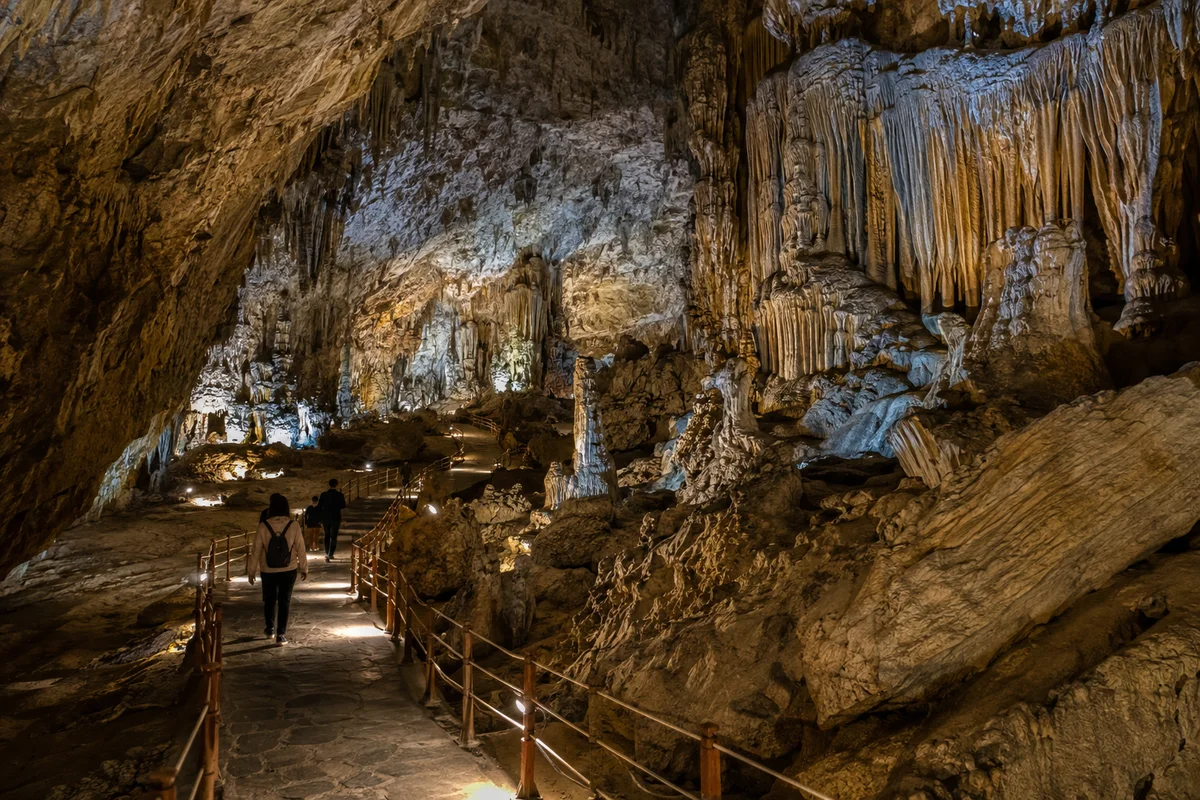
Ha Long’s caves and marine lakes are part of a drowned limestone-karst landscape. UNESCO describes a large system of tower karst, shore notches and caves formed where tropical limestone terrain meets the sea. For a traveller, however, geology is only half the story: each place has a different transfer, walking load and exposure to crowds.
Quick comparison of the best-known stops
| Stop | What the visit usually involves | Main limitation |
|---|---|---|
| Sung Sot Cave | Landing on Bo Hon Island, a steep approach and a one-way walk through large lit chambers | Stairs, humidity and concentrated groups |
| Ti Top Island | Beach-level landing with an optional climb to a high bay viewpoint | A steep, exposed stairway and limited shore time |
| Luon Cave | Transfer to a kayak or rowed boat through a low sea-level passage into a lagoon | Tide, head clearance, small-craft access and weather |
| Thien Cung Grotto | Constructed show-cave route, often paired with Dau Go on a shorter itinerary | Steps and artificial lighting; route-one access only |
| Dau Go Cave | Cave visit on the same broad island area as Thien Cung | Exact combination and walking time vary by itinerary |
| Cua Van Floating Cultural Center | A route-dependent cultural stop reached by boat | Exhibits, performances and small-boat activities are not guaranteed on every sailing |
These are route components, not places to assemble independently. The official Ha Long itinerary list places Thien Cung and Dau Go on Itinerary 1, while Sung Sot, Ti Top and Luon appear within the larger Itinerary 2 set. An individual operator may use only part of the authorised list, so insist on the named stops in writing.
Sung Sot Cave: the substantial cave walk
Sung Sot (often translated as Surprise Cave) is on the Bo Hon island group. The official attraction page identifies it as a major karst cave and notes that it is reached from both principal Ha Long passenger ports by boat.
The approach matters more than promotional descriptions. The official route account places the cave above sea level and describes the access as steep. Expect stairs before the main chambers, more movement inside, warm humid air and periods when multiple groups are funnelled along the same path.
Ask your operator:
- whether the cave walk is one-way or returns along the same route;
- the approximate walking time from landing to re-boarding;
- whether the tender or vessel waits for passengers who opt out;
- where the group meets if someone turns back;
- whether handrails and lighting cover the whole public route.
Closed shoes with grip are more useful than beach sandals. Do not touch formations or step outside barriers, even when another visitor is doing so.
Ti Top Island: beach level or viewpoint climb
Ti Top is often sold through the viewpoint photograph, but the landing has two different experiences. Staying near beach level is a lower-effort stop; climbing the stairway gives a broad view over the bay but requires sustained ascent and descent.
Do not let a short shore window force a climb that is wrong for your knees, balance or heat tolerance. Ask how many minutes are allowed from landing until the final tender, then keep a return margin. The upper path can feel much hotter and less breezy than the boat deck. After rain, treat every tread and handrail as potentially slippery.
Swimming is never guaranteed merely because there is a beach. Water conditions, local instructions and the day’s operating decision apply. Bring swimwear only if your operator confirms swimming is planned, and do not leave valuables unattended while trying to combine the beach and summit.
Luon Cave: a water-level passage, not a walk-through cave
Luon is fundamentally different from Sung Sot. The management authority’s description explains that a low tunnel connects open water to a lake enclosed by limestone cliffs, normally entered by kayak or bamboo rowing boat.
Choose the rowed boat if you do not want to paddle, if getting in and out of a kayak is unsuitable, or if the operator’s supervision is unclear. In either craft, wear the life jacket properly and keep hands inside when passing close to rock. Tide can alter clearance below the roof.
Wild macaques may be visible around the cliffs. Do not feed, touch or call them toward the boats. Food changes wildlife behaviour and close contact is unsafe for people and animals.
Thien Cung and Dau Go: understand the route-one pairing
Thien Cung Grotto and Dau Go Cave sit in the south-western approach to the bay and appear on the authority’s Itinerary 1. They can suit a shorter outing focused on caves and recognisable islets. That does not make them a compressed version of the Sung Sot-Ti Top-Luon programme; they are a different route pattern.
If an agent says only “cave visit”, ask for the cave name. This single question prevents many booking mismatches. It also lets you compare the walking load with your group’s needs.
Cua Van Floating Cultural Center: a cultural route stop
Cua Van is different from a cave landing or beach call. The Ha Long Bay management authority lists the Floating Cultural Center among the bay’s managed attractions, preserving material connected with the history and traditions of the former fishing community. Treat it as a cultural heritage stop, not permission to enter working homes or photograph people without consent.
The centre is reached as part of an authorised water route: the authority’s Itinerary 3 explicitly names Cua Van. Ask whether your programme uses that route, how visitors transfer from the main vessel and how much time is actually allowed. Kayaking, rowed boats, displays or performances can depend on the approved programme and conditions; the authority’s 2026 update on traditional singing preparation is evidence of cultural work at the centre, not a promise of a performance on every visit.
The accessible alternative: stay with the vessel
For some travellers, the best part of Ha Long is the view from the water rather than a crowded landing. Ask in advance whether a shaded deck, salon and toilet remain accessible while other passengers disembark. On small vessels, staying aboard may not always be allowed during a transfer; get a clear answer before booking.
A scenic-first cruise with fewer landings may work better for someone who uses a mobility aid, struggles with heat or simply wants unhurried landscape time. The cruise selection guide gives the questions to send an operator.
Crowd, weather and timing strategy
Cave crowding comes in pulses as boats arrive, not as a steady queue. Travellers cannot reliably choose an empty time because authorised route schedules and harbour movements control the sequence. A private transfer does not grant private access to a public attraction.
Weather can change what runs. Heavy rain makes steps and pontoons harder; strong wind, poor visibility or official restrictions can close a kayak or swimming activity. A responsible operator should explain the substitute or refund policy before payment. See weather and timing and safety and packing before committing to a tight plan.
Check the route and the physical demands separately
The official Ha Long Bay attractions directory confirms the managed sites, while the route catalogue shows which places can belong to the same itinerary. Neither source describes how a particular traveller will experience the stairs, humidity or crowd flow. Ask the operator for concrete walking and transfer details, and never treat an old itinerary as proof of today’s opening status, ticket inclusion or safety decision.
Sources and live verification
- Ha Long Bay official attractions directory for managed sites and route relationships.
- UNESCO World Heritage description for the landscape’s karst formation and conservation context.
- Wikipedia’s Ha Long Bay article for orientation and terminology; verify visitor operations with the management authority.
- The management authority’s Cua Van cultural programme update for current evidence of the centre’s heritage work.
Verify again on sailing day: the named route, which stops will actually operate, footwear advice, swim or kayak status, tender arrangements and the latest return time.
Put it on the map
Addresses and map points
Use these points for orientation, then match the exact terminal, entrance or meeting place to your current confirmation.
Sung Sot Cave
Bo Hon Island, Ha Long BayVietnamReached as an authorised cruise stop, not by an independent road journey.
Ti Top Island
Ha Long BayVietnamA route-dependent island landing with a beach area and a steep viewpoint climb.
Luon Cave
Bo Hon Island, Ha Long BayVietnamThe enclosed lake is normally approached through a low sea-level passage by kayak or rowed boat.
Cua Van Floating Cultural Center
Cua Van, Ha Long BayVietnamA boat-route cultural stop; access and activities must be included by the licensed operator.
Keep exploring